

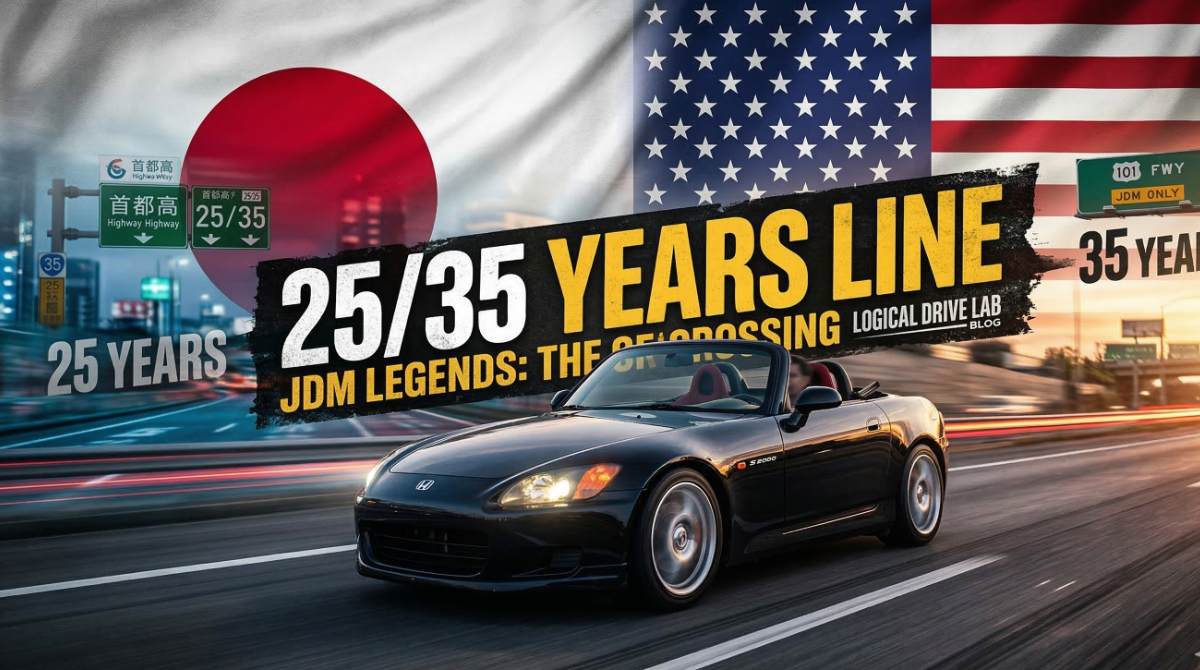
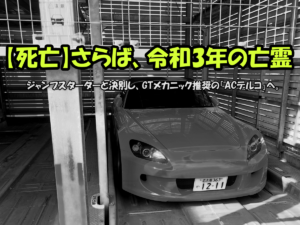
“After 25 years, it’ll sell for a high price in America.” Such trendy words have dominated the JDM scene for far too long. My S2000 (AP1) has finally entered the range of that “25-Year Rule.” However, I dare to say: “Those who are getting excited over the 25-year rule are still mere amateurs.”
Let me get straight to the point. What we are truly facing now is not the liberation (export) of the 25th year. It is the “Absolute Disconnection” known as the 35th year that lies beyond.
■ The “End” of the 25-Year Rule: It’s No Longer Rare Value
Once, when the R32 GT-R hit 25 years, it was a “Revolution.” But how is the market in 2026? S2000, R34, Silvia S15—those former masterpieces are being unleashed one after another, and American ports are overflowing with Japanese cars. The bonus time where “prices jump just because it’s 25 years old” is coming to an end.
Think about it logically: if supply increases, prices stabilize. Furthermore, the strict environmental regulations (ACCII) starting in 2026, led by California, are attempting to push gasoline cars into the realm of “relics of the past.” Beaten-up units that are merely 25 years old will eventually be swallowed by massive maintenance costs and the wave of regulations.
■ An Invitation to the “Sanctuary” of the 35-Year Rule
So, who are the true winners? It is those who endure until the “35th Year.” In America, besides the rule where import is deregulated at 25 years, there is a system in many states where cars are recognized as “Antique Cars (Classic Cars)” at 35 years (or around 30 to 35 years from manufacture).
When you cross this “35-Year Wall,” the car is promoted from a mere “used sports car” to a “Running Cultural Heritage” exempt from many regulations and emissions tests. Now in 2026, what S2000 owners should aim for is not selling at the 25th-year mark for immediate profit. It is to endure another 10 years and drive your beloved car into this “35-Year Sanctuary.”
■ The Logic of a Man Decided on “Going Down with the Ship”
The reason I keep gripping the key of my S2000, even after losing 4kg to Norovirus and feeling lightheaded. It is to take this car all the way to the “Glory of the 35th Year.”
As of 2026, the social climate toward gasoline cars is intense. The grand cause called “Carbon Neutrality” is trying to drown out our VTEC sound. But just 10 more years. If we maintain it for another 10 years, the S2000’s social standing will flip 180 degrees—from a “source of environmental pollution” to a “Work of Art to be Preserved.”
At that time, the world should realize. The fact that there was an engine that revved to 9,000 RPM, handling like a razor, and a “crazed owner who sat in a full bucket seat even while suffering from Norovirus in 2026.”
■ Conclusion: I will keep reving until 2035
Flush the logic of those acting like investors, saying “I maintain it because it’ll sell for a high price,” down the toilet. What I propose is the “35-Year Completion Logic.” Even if parts become discontinued, I will use up Honda’s heritage programs or even hack overseas restomod technologies to pass through the gates of 2035.
At that time, what will be beside me is not a stack of bills from an investment. It will be my oily, most beloved S2000, having survived 35 years together.
“Those who sell at 25 years are just customers. Those who ride for 35 years are the True Owners.”
関連投稿:
 Every S2000 Owner Must Pay Respect! Explaining the “3 Great Sanctuaries” of Tuning Makers.
 [Tragedy] The Fate of a Man Who Tried to Dye His S2000 Soft Top “Espresso Brown.” What is the “Blood Lesson” Gained After Throwing 20,000 Yen and a Day into the Gutter?
 [Supreme] Maintaining an S2000 Isn’t About “Money,” It’s About “Love” and “Ingenuity”! Why I Still Rev the VTEC in 2026 After Being Abandoned by Online Insurance.
 [Pure Self-Satisfaction] A Pharma Professional’s “S2000 Obsession” Explodes! | Logical Drive Lab





Comments